
The Golden Age of Scandinavian Cinema
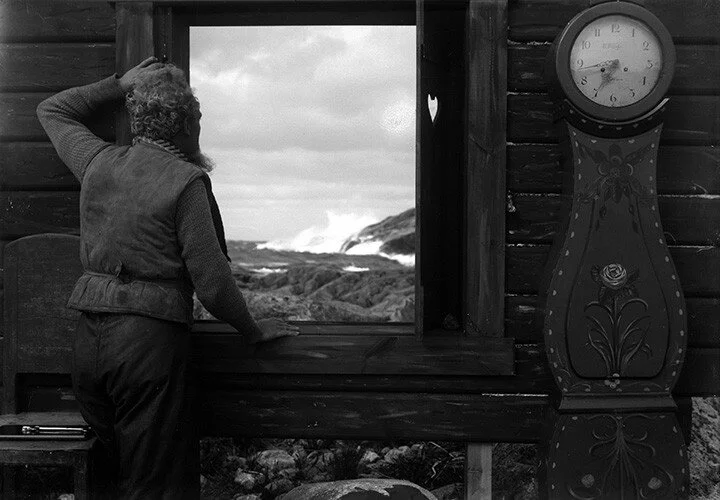
Victor Sjostrom in A Man There Was
The Early Films of Victor Sjostrom
I've been watching early silent films from the rugged northern reaches of Europe. Taking a chance on Victor Sjostrom's A Man There Was got me interested, then seeing Sjostrom's A Thief and His Wife got me hooked. Watching Phantom Carriage blew me away.
There was a brief period when these films excelled anything else being done in cinema. While American silent films were entertaining though slapstick comedy, Scandinavian filmmakers were probing the human soul in a series of powerful dramas. This creative period didn't last, as Hollywood films flooded the global marketplace overwhelming for a time local film cultures. Scandinavia wouldn't have another significant impact on cinema until Bergman hit the scene. But for a brief period after the First World War, Scandinavian films held center stage.
The first thing that hits you when you see these films is the powerful presence of the natural world - the raging sea in A Man There Was, the high mountains on An Outlaw and His Wife. The natural world is a character in the films; humans struggle to work out their destiny while being buffeted by these massive natural forces.
Sjostrom based his 1917 film Terje Vigen, released in the United States as A Man There Was, on a poem by Sweden's great playwright Henric Ibsen. It is set on the rugged northern coastline of Norway. The film opens with an interior shot of a grizzled old man brooding by a small fire in his tiny cabin. He gets up and opens a window onto a wild tossing ocean storm. He leans into the force of the wind and recalls his past.
Most of the film is a flashback to happier times when Terje lived in a peaceful tiny cottage by the sea with his wife and child. Then war came and his village was blockaded by the British navy. To prevent his family from starving, he tries to run the blockade in search of food. He is discovered, taken prisoner and is thrown into prison by a brash young British sea captain who ignores his desperate pleas for sympathy. Separated from his family for five years, he is finally able to return to his cottage when the war ends only to discover that his wife and child are dead and buried in the village cemetery.
Crushed by the loss, he broods through a meager life as a ship pilot until the storm that opens the film brings into sight a damaged ship tossed toward the rocky shoals. Instinctively, he rushes to his boat and paddles out to save the ship, only to discover that the man sailing the ship is the same British captain who had heartlessly thrown him into prison years earlier. Terje is gripped by a thirst for vengeance, thinking to destroy the ship before he rights himself and brings the family safely to shore.
A Man there Was is a powerful story of revenge and redemption, in which humans must work out their destiny while buffeted by the powerful, overwhelming forces of nature.
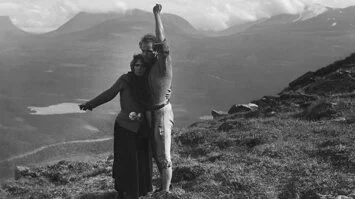
The Outlaw and His Wife
Sjostram continued to explore these themes in his 1918 film, An Outlaw and his Wife, this time set in the high mountains of Iceland.
The films opens with lyrical scenes of a prosperous farm in a sunny valley headed by a generous widow, Halla, who celebrates the harvest with her farmhands. Into this bucolic scene comes a traveling stranger who calls himself Kari and who quickly befriends everyone with his sunny personality. Kari and Halla fall in love and are just making their wedding plans when the local bailiff arrives and accuses the Kari of being an escaped thief, whose real name is Ejvind.
A flashback sequence follows in which Kari/Ejvind tells Halla the story of his past, when he was forced to steal a sheep to feed his family living in desperate poverty. Captured and thrown into prison, he escaped and was on the run when he came to Halla's farm. With the bailiff and his posse bearing down on the farm to arrest the outlaw, the couple decide to leave everything and flee to the high mountains in a desperate escape.
The heart of the film unfolds the years they lived as outlaws from society, scratching out a simple but happy life in their mountain hideaway. Stunning scenes of the alpine vastness of Iceland shape this part of the film. I was struck by how much of Sjostroms power as a filmmaker comes from his outdoor shooting. While most silent films were shot in the controlled safety of film studios, Sjostrom took his cameras out into the rugged landscapes of nordic Europe, where the elements could shape the story. Sjostrom, working with his talented cinematographer, Julius Jaenzon, fills the screen with panoramic scenes of the alpine vastness, in which tiny humans are part of the tapestry, almost like a Chinese landscape painting. Humans struggle through their destinies battered and tossed by powerful natural elements.